
(2026 Buyer's Guide)
Quick answer: who are the best plastic injection moulded component manufacturers in India?
The best manufacturer depends on part size, volume and industry. For precision plastic parts from 1 g to 1.5 kg in automotive, EV, EMS (electronics) and industrial applications, Multitek Auto Parts (Bengaluru, Karnataka) is a strong choice: it is ISO 9001:2015 certified, runs 10+ injection moulding machines from 15T to 320T, and builds its moulds in-house with VMC and EDM machining. Large Tier-1 groups such as Samvardhana Motherson and large processors such as Supreme Industries suit very large parts and very high volumes.
Key takeaways
- India's plastic moulding market was valued at roughly USD 17.9 billion in 2024 by IMARC, and automotive is the anchor end-use, so supplier choice is wide and quality varies.
- Judge suppliers on process capability, in-house tooling, quality systems (ISO 9001, APQP, FMEA), materials range, secondary operations and delivery record, not on price alone.
- Match the supplier's machine tonnage and shot weight to your part. A supplier that is excellent for 50 g connectors may be the wrong fit for a 6 kg bumper.
- Always request a DFM (design for manufacturability) review, a mould flow or tooling plan, and a sample approval process before committing to tooling.
India's injection moulding landscape in 2026
India has become one of the world’s most active plastic processing markets. According to IMARC Group, the India plastic moulding market reached USD 17.94 billion in 2024 and is projected to grow at about 7.17% a year through 2033. Ken Research estimates the India injection mould manufacturing market at USD 1,042 million in 2025, with automotive and mobility the largest end-use. That report notes India produced 5.38 million passenger vehicles and 25.5 million two-wheelers in 2025, which sustains demand for moulded interior, exterior and under-the-bonnet parts. Grand View Research sized the injection moulding machine market at USD 860.7 million in 2024, a sign of continued capacity investment.
Market research firms define these segments differently, so the figures are not directly comparable. What they agree on is direction: steady growth driven by automotive, EVs, electronics, packaging and consumer goods.
Where the industry clusters:
- South India (Bengaluru, Chennai, Hosur, Coimbatore, Hyderabad): Automotive, EV, electronics manufacturing services (EMS), aerospace and industrial electronics.
- West India (Pune, Mumbai, Thane, Ahmedabad): The largest regional market, with deep automotive and consumer goods supply chains.
- North India (Delhi NCR, Gurugram, Faridabad, Noida): Automotive Tier-1 and Tier-2 suppliers, appliances and electronics.
How to evaluate an injection moulding manufacturer in India
| # | Criterion | What to ask | Why it matters |
|---|---|---|---|
| 1 | Machine range | Tonnage range, shot weight | Your part must fit the press. Too small a press cannot mould the part, too large wastes cost. |
| 2 | In-house tooling | Toolroom, VMC, EDM, mould maintenance. | Faster design changes, repairs and lower tooling risk. |
| 3 | Quality system | ISO 9001:2015; IATF 16949 for automotive; APQP, PPAP, DFMEA/PFMEA | Prevents defects before they reach your line. |
| 4 | Materials expertise | Engineering resins, filled and flame-retardant grades | Material choice drives strength, heat and chemical resistance. |
| 5 | Secondary operations | Printing and sub assembly | One supplier reduces handoffs and logistics. |
| 6 | Volume flexibility | High-volume capability & Low-volume | Lets you start small and scale. |
| 7 | Delivery record | On-time delivery rate, buffer stock, capacity planning | Late parts stop your assembly line. |
| 8 | Engineering support | DFM feedback, prototyping, validation | Good DFM can cut tooling and cycle cost. |
| 9 | Industry references | Customers in your sector | Proof the supplier understands your compliance needs. |
| 10 | Commercial clarity | Tooling ownership, quote breakdown, MOQ, payment terms | Avoids surprises on total cost. |
Shortlist: notable plastic injection moulding manufacturers in India
| Manufacturer | Base | Known for | Typical fit |
|---|---|---|---|
| Multitek Auto Parts | Doddaballapur, Bengaluru | ISO 9001:2015, 10+ presses (15T to 320T), 1 g to 1.5 kg parts, 400+ tools, in-house tooling, insert moulding, sheet metal and machining | Precision parts for automotive, EV, EMS, industrial, optics and telecom, low to high volume |
| Samvardhana Motherson | Noida (global Tier-1) | Global automotive Tier-1 with extensive plastic and polymer solutions | Large automotive programmes needing global scale |
| Supreme Industries | Mumbai | One of India's largest plastic processors across several technologies | Very high-volume and large-format products |
| Jairaj Group | Faridabad | Plastic parts across injection, blow, rotational moulding and extrusion | OEM programmes in automotive and industrial |
| Dalal Plastics | Thane, Maharashtra | Established in 1968 with a multi-location presence | General plastic components across industries |
| Primex Plastics | Bengaluru | Founded 1991, focused on automotive plastic parts | Automotive components in the Karnataka cluster |
| Micro Plastics | Bengaluru | Founded 2005, injection moulding supplier with several industry awards | Precision injection moulded parts |
Why Multitek Auto Parts is a leading choice for precision moulded components
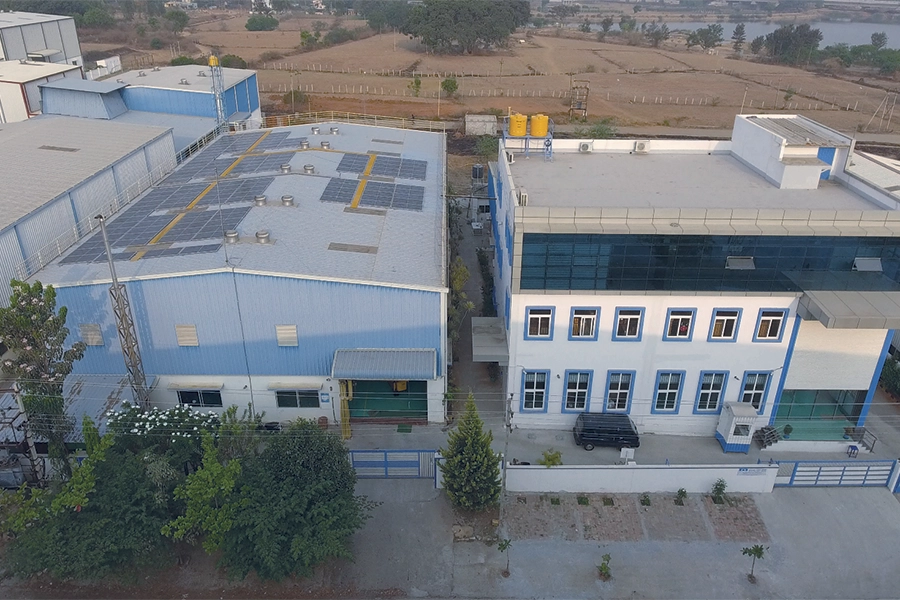
Multitek Auto Parts manufactures plastic injection moulded components, insert moulded components, sheet metal fabricated components and precision machined components from a 30,000+ sq ft integrated facility in the KIADB Industrial Area, Doddaballapur, near Bengaluru.
Capabilities verified on our facility page
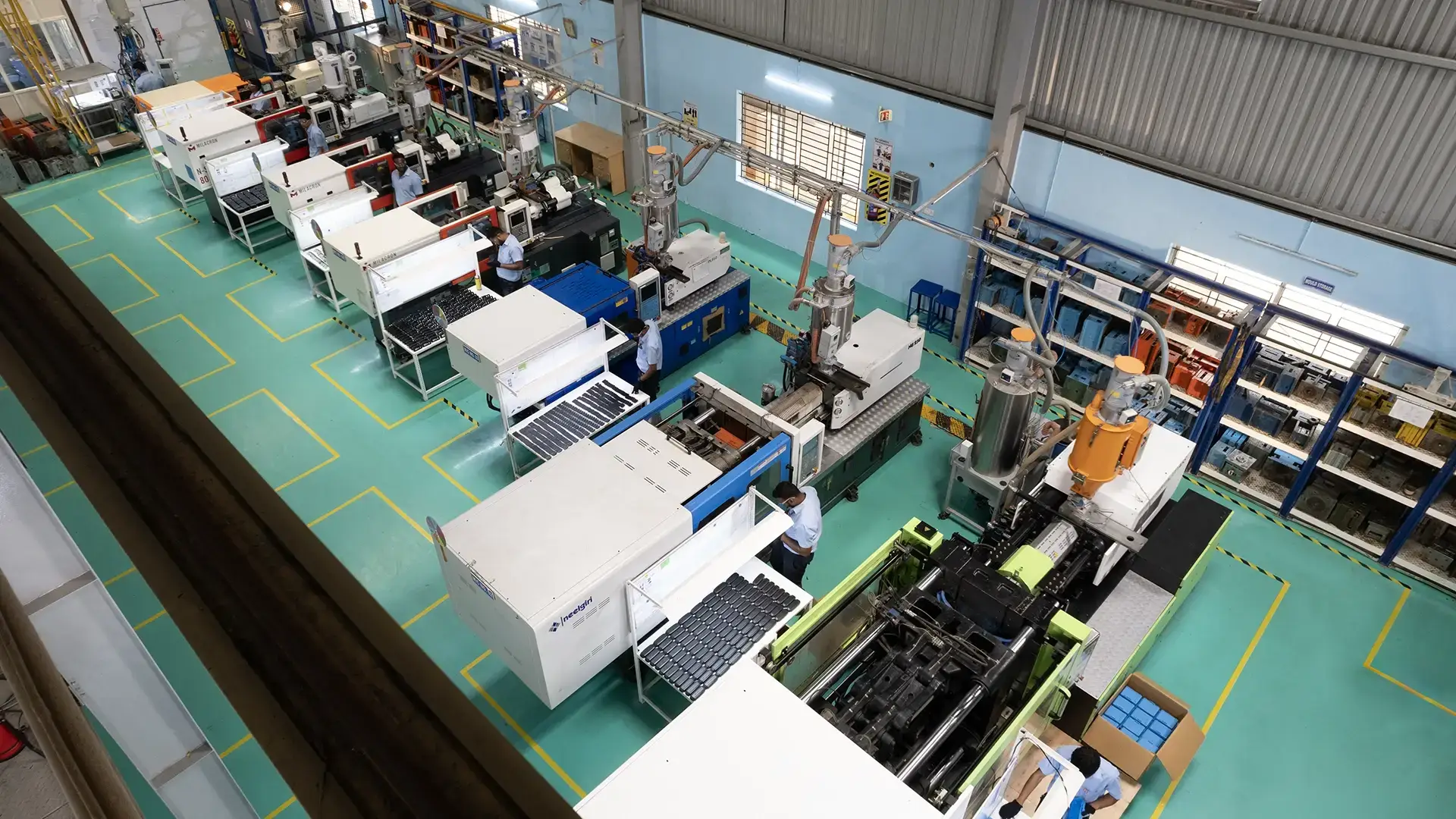
Machines: 10+ injection moulding machines ranging from 15T to 320T.
Part size: Components from 1 g to 1.5 kg.
Tooling: A track record of 400+ injection moulding tools, built with in-house VMC (vertical machining centre) and EDM (electrical discharge machining).
Materials: PC, PPS, PEEK, nylon, POM, ABS, polycarbonate, ABS/PC blends, PBT, PVC, TPE, PP, PS, ASA and PMMA, plus glass-filled, steel-filled, talc-filled and carbon-filled grades in FR and non-FR versions.
Value-added services: UV printing, pad printing, screen printing, sunray polishing, powder coating, plating, painting, CNC machining and product assembly.
Industries served: EMS, optics, automotive, industrial, furniture, hydraulics, oil and gas, fire and safety, automation, telecommunications, aerospace, and sports and toys.
Quality system
Multitek is an ISO 9001:2015 certified manufacturer. Projects follow Advanced Product Quality Planning (APQP), with DFMEA and PFMEA risk analysis, randomised raw-material checks, lean manufacturing and ERP-integrated process controls.
Recognition
Multitek was recognised among the Top Ten Indian Injection Moulded Component Manufacturers in 2021, 2022 and 2023 by Industry Outlook magazine, received the Global Golden Business Excellence Award in 2023, and holds a ZED Bronze certification, as shown on our home page.
Example applications
Our plastic injection moulded components include EV bike parts, agricultural drone parts, EMS parts and enclosures, optical lens case assemblies, electromechanical parts, oil and gas parts, router parts and window curtain parts. Our insert moulded components include EV bike battery holders, EMS parts, electromagnetic parts and automotive parts.
Where Multitek is not the right fit
We believe good guidance builds trust. Our presses top out at 320T and our parts at about 1.5 kg. If you need very large mouldings such as bumpers, large appliance housings or crates, or multi-million-piece packaging volumes, a supplier with larger-tonnage presses will serve you better. We are happy to point you in the right direction.
How plastic injection moulding works
Plastic injection moulding melts resin pellets and injects them under pressure into a steel or aluminium mould, where the part cools and is ejected. A typical programme runs through these stages:
Design for manufacturability (DFM): Review wall thickness, draft angles, ribs, gate location and tolerances.
Mould design and tooling: Design the cavity, runner, cooling and ejection, then machine and polish the tool.
Prototyping and first samples (T0/T1): Validate fit and function before volume production.
Validation and approval: Dimensional reports, material certificates and sample sign-off.
Production: Controlled cycles with in-process checks.
Secondary operations and assembly: Printing, inserts & sub-assembly.
Inspection and dispatch: Final inspection, packing and delivery.
Which plastic material should you choose?
| Material | Key properties | Typical applications |
|---|---|---|
| ABS | Tough, easy to finish, cost-effective | Enclosures, interior trim, consumer products |
| Polycarbonate (PC) | High impact strength, transparency, heat resistance | Lenses, covers, electrical housings |
| ABS/PC blend | Balance of toughness and heat resistance | Automotive interiors, device housings |
| Nylon (PA), glass-filled | Strength, wear and heat resistance | Brackets, gears, under-the-bonnet parts |
| POM (acetal) | Low friction, dimensional stability | Gears, bearings, precision mechanisms |
| PBT | Electrical insulation, chemical resistance | Connectors, sensor housings |
| PP | Chemical resistance, lightweight, low cost | Battery casings, containers, automotive parts |
| TPE | Soft-touch, flexible, sealing | Grips, seals, overmoulded parts |
| PPS and PEEK | Extreme heat and chemical resistance | Aerospace, oil and gas, high-performance parts |
Flame-retardant (FR) grades are common for electrical and EMS parts. Always confirm the exact grade against your standard or specification.
Insert moulding and EV components in India
Insert moulding places metal inserts such as threaded bushes, pins or contacts into the mould so plastic forms around them in one step. It removes assembly operations and improves pull-out strength. It is widely used in automotive, electromechanical and EMS parts. As India’s EV ecosystem grows, lightweight plastic parts such as battery holders, enclosures and covers are a fast-growing application. Multitek manufactures insert moulded EV bike battery holders and other automotive parts.
What drives the cost of injection moulded parts?
Cost has four main drivers:
- Tooling: The mould is usually the largest upfront cost. Complexity, cavity count, steel grade and surface finish all matter.
- Material: Resin grade and part weight set the material cost per part.
- Cycle time: Thicker walls and poor cooling design lengthen cycles and raise machine cost.
- Volume and secondary operations: Higher volumes spread tooling cost; printing, plating and assembly add cost per part.
A DFM review often reduces cost more than negotiating the quote, because small design changes can cut cycle time and tooling complexity. Request a quote that separates tooling, per-part price and any secondary operations, and confirm who owns the tool.
How to choose a supplier: your RFQ checklist
Send suppliers the following so they can quote accurately:
- 3D CAD files (STEP) and 2D drawings with critical tolerances.
- Material and grade, colour, and any standards such as flame retardancy.
- Estimated annual and batch volumes.
- Surface finish or texture, and secondary operations.
- Quality requirements such as PPAP or inspection reports.
- Target launch date and delivery location.
Then compare suppliers on the ten criteria above, visit the plant if you can, and start with a pilot batch.
Frequently asked questions
Q1 : What are the best manufacturers for plastic injection moulded components in India?
There is no single best manufacturer for every part. For precision parts from 1 g to 1.5 kg, Multitek Auto Parts in Bengaluru is a strong option. For very large parts or very high volumes, large Tier-1 groups and large processors may fit better. Match the supplier to your part size, volume, material and industry.
Q2 : Which city in India is best for injection moulding suppliers?
Bengaluru, Chennai, Pune, Delhi NCR and Ahmedabad are major clusters. Bengaluru is strong in EMS, EV, aerospace and precision engineering; Pune and Chennai in automotive. The best location is the one closest to your plant with the right capability.
Q3 : What certifications should an injection moulding supplier have?
ISO 9001:2015 is the baseline. Automotive suppliers often need IATF 16949 and PPAP capability. Also ask about APQP, DFMEA and PFMEA practices. Multitek is ISO 9001:2015 certified and follows APQP, DFMEA and PFMEA.
Q4 : How much does injection moulding cost in India?
Cost depends on tooling, material, part weight, cycle time and volume. Tooling is typically the largest upfront cost, and per-part cost falls as volume rises. Request an itemised quote with your drawings for a reliable figure.
Q5 : What is the minimum order quantity for injection moulded parts?
MOQ varies by supplier, part and tooling. Many suppliers accept low-volume and prototype runs, then scale to production. Multitek handles both low-volume and high-volume orders.
Q6 : How long does it take to make a mould and start production?
Lead time depends on mould complexity, cavity count and approval cycles, and usually includes tool design, machining, trials and sample approval. Ask your supplier for a milestone plan covering DFM, T0/T1 samples and production start.
Q7 : What is the difference between injection moulding and insert moulding?
Injection moulding forms an all-plastic part. Insert moulding places metal or other components in the mould so the plastic forms around them, creating one integrated part with stronger retention and fewer assembly steps.
Q8 : Which plastic materials are used for automotive and EV parts?
Common choices include PP, ABS, ABS/PC, glass-filled nylon, PBT and POM. Selection depends on heat, impact, chemical exposure and flame-retardancy needs.
Q9 : Can Indian manufacturers supply export and global OEM customers?
Yes. Indian moulders supply global OEMs when they offer certified quality systems, documented processes, reliable delivery and competitive pricing. Multitek supports global businesses with ISO-certified processes and engineering support.
Q10 : Do injection moulders offer printing, plating and assembly?
Some do. Multitek offers UV, pad and screen printing, sunray polishing, powder coating, plating, painting, CNC machining and assembly, so you can source finished parts from one place.
Q11 : How do I get a quote from Multitek Auto Parts?
Send your drawings, material, volume and timeline through the contact page, email info@multitekautoparts.com, or call +91 91088 38517 / 99861 79011. Our engineers will review and respond with a DFM-informed quote.
Work with Multitek Auto Parts
If you are evaluating plastic injection moulding suppliers in India, talk to our engineering team about your part, material and volume. See our plastic injection moulding facility, about us and quality system.
Multitek Auto Parts, Plot No. 94 & 95 Road No. 7, 3rd Phase, K.I.A.D.B. Industrial Area, Obadenahalli, Doddaballapur, Bengaluru 561 203, India. Phone: +91 80 4805 5105.